The Abstract verses the Non-Representational – Ewen MacDonald
What’s in a term? The abstract: is that which is not rational, but is aberrant, distant, deviant, renegade, repulsive, vague, strange, a being on the outer cusp of the liminal, yet not quite absorbed by the subliminal. It is an in-between verse. The purgatory of art: not quite one thing or the other. The loss of the promise of paradise without the condemnation of hell. It sits and waits for a judgement which never comes.
That is a man, a woman, a tree, a field, a boat, a street, a cat, a building, a sunset. Or is it? That is paint drying in ruination. A baseless mirage, an approximation, of something. But is it the thing that I think that I see? Is it not something else, or nothing in particular?
If I squint, if I purse my eyes shut tight enough, then that building is a ship, that lawn a lake, that car a crate, that mouse a monster. The world recedes and I am the creator.
The corporeal realm owes its likeness to that which I ascribe to it. It will submit and surrender, under duress perhaps, to my reflection, refraction, to my abstraction. I view life as I chose to view it and life chooses how to view itself. Nothing is simple: nothing is resolute.
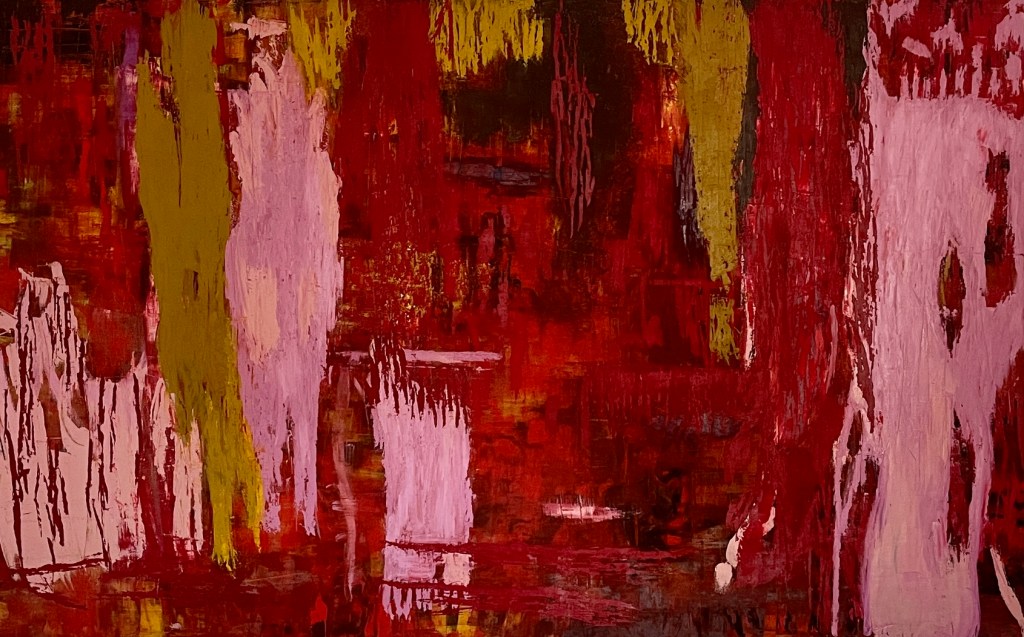
The Non-Representational is a feeling, a pulse, an attraction, a repulsion, a magnetic force inside of the artist’s soul. It is spiritualism and shamanism, it is objective and instinctive, at once real and imagined. It spreads out from the mind, the blood cells, the hands and the spirit of the artist. It is resolutely untethered to the concrete nature of the world which surrounds us, but it captures a physicality all of its own. What is more physical than the nature of a Jackson Pollock ‘drip’ painting?
The beginnings of modern abstract painting are generally traced back to the Russian male artist Wassily Kandinsky, but may in fact, belong to the Swedish female artist Hilma af Klint, who is receiving something of a renaissance, or ‘discovery’ (that most chauvinistic of terms) in the contemporary art world. Both artists’ works and process can be identified as being in some way spiritual in nature, Klint’s certainly were.
Colour, shape and form play a dynamic and idiosyncratic role in both artist’s work. These paintings are filled with circles, triangles, points and mixed perspectives, that would have confused and infuriated the Renaissance masters. Klint’s work is more radiant and hallucinogenic, more tactile and soothing. Kandinsky’s art is all angles and sharp points, more protruding and aggressive. It would not be too clichéd, I think, to consider Klint’s work more female and Kandinsky’s more male.
However complex these art works are, they are still tethered to a certain reality: that of identifiable lines and shapes and mark making. Though their composition and execution may owe as much to the non-representational as the abstract. More of a pure abstraction than a detour from the reality presented to us by the physical world.
Kazimir Malevich may be deemed as the father of the non-representational in western art. His art movement of Suprematism sought to move art away from the concrete into the realms of inner feelings and again spiritualism (there’s a theme developing here). His black square can be viewed as the precursor to many an art work, from Abstract Expressionism to Minimalism. From Frank Stella’s Black Series to Anish Kapoor’s work with Vantablack, (alleged to be the blackest black in the world).
A certain abstraction creeps into the world of figurative art. Picasso’s cubist images are difficult to discern. That is the face of a human figure, that is a violin, but not entirely recognisably so. It is presented to us in the complex ways we interact with the world. It is the 2D world of painting forced into a 3D abstraction. It is truth, but it is a confusing and abstract truth. Cubism is the painterly equivalent of the splitting of the atom and we are still learning to be its contemporaries.
Picasso never went full abstract, nor did his great rival and sparring partner Matisse. They both dipped their toes into abstraction though. Matisse with his wonderful and enigmatic painting French Window at Collioure. The strips of vertical colours hint only at the scene through the addition of the title. This painting was understandably an inspiration to Mark Rothko. In the 1950’s Matisse also produced his late career cut-out The Snail, which again, without the aid of a title, would be practically speaking, a full abstraction.
However, neither Picasso nor Matisse could be accused of being ‘spiritual’ artists. They were both far more scientific in their approach and Picasso was a fully paid up member of the French Communist party (not noted for their sympathetic attitude towards the spiritual in life).
Piet Mondrian is probably the artist our mind first lurches toward and latches onto when we hear the word ‘abstract’. He is also often considered a non-representational artist. He was inspired by nature, but sought out a formula to express general beauty on a flat surface. You can’t find a tree, a corn field, or a cow, in one of Mondrian’s abstractions however hard you squint your eye.
His abstractions still have identifiable lines and shapes and hold a very rigidly stylized, geometric composition. In spite of Mondrian’s protestations to the contrary, his art feels well thought out and meticulously designed. There is nothing shamanistic in these paintings.
To think of the non-representational in art I always wander first and foremost to those twin behemoths of 20th Century American art: Mark Rothko and Jackson Pollock. Their classic paintings are works of sublime creativity cast out by a purely artistic soul. What does their work mean? Whatever we feel them to mean. They are as immersive as painting gets. They are pure abstraction, pure painting, pure art. There was nothing left after them. They took painting as far away from its foundations and beginnings as it was possible to go. They elicit a feeling in the viewer’s psyche, not intellect. After them was Pop Art and the return of the figurative to art: all soup cans and drowning girls, rendered cartoonishly, but very recognisably real. There was little room for deep and heavy, intellectual and spiritual, abstraction here.
There is a disconnect somewhere between the abstract and the non-representational, but it is all sliding borders and blurring lines. The best way of considering art, is as a spectrum and each art work has its place, from the photorealist to the impressionistic, from the expressionistic to the geometric, from diminishing composition to no composition at all, in the end, just a blank untreated canvas.
 Carol Burns